



我们继续讲解LINQ to SQL语句,这篇我们来讨论Group By/Having操作符和Exists/In/Any/All/Contains操作符。
Group By/Having操作符
适用场景:分组数据,为我们查找数据缩小范围。
说明:分配并返回对传入参数进行分组操作后的可枚举对象。分组;延迟
1.简单形式:
var q =
    from p in db.Products
    group p by p.CategoryID into g
    select g;
语句描述:使用Group By按CategoryID划分产品。
说明:from p in db.Products 表示从表中将产品对象取出来。group p by p.CategoryID into g表示对p按CategoryID字段归类。其结果命名为g,一旦重新命名,p的作用域就结束了,所以,最后select时,只能select g。当然,也不必重新命名可以这样写:
var q =
    from p in db.Products
    group p by p.CategoryID;
我们用示意图表示:
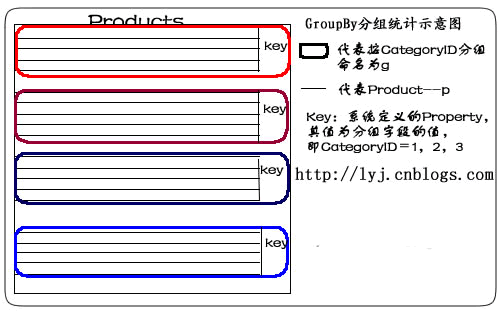
如果想遍历某类别中所有记录,这样:
foreach (var gp in q)
{
    if (gp.Key == 2)
    {
        foreach (var item in gp)
        {
            //do something
        }
    }
}
2.Select匿名类:
var q =
    from p in db.Products
    group p by p.CategoryID into g
    select new { CategoryID = g.Key, g };
说明:在这句LINQ语句中,有2个property:CategoryID和g。这个匿名类,其实质是对返回结果集重新进行了包装。把g的property封装成一个完整的分组。如下图所示:

如果想遍历某匿名类中所有记录,要这么做:
foreach (var gp in q)
{
    if (gp.CategoryID == 2)
    {
        foreach (var item in gp.g)
        {
            //do something
        }
    }
}
3.最大值
var q =
    from p in db.Products
    group p by p.CategoryID into g
    select new {
        g.Key,
        MaxPrice = g.Max(p => p.UnitPrice)
    };
语句描述:使用Group By和Max查找每个CategoryID的最高单价。
说明:先按CategoryID归类,判断各个分类产品中单价最大的Products。取出CategoryID值,并把UnitPrice值赋给MaxPrice。
4.最小值
var q =
    from p in db.Products
    group p by p.CategoryID into g
    select new {
        g.Key,
        MinPrice = g.Min(p => p.UnitPrice)
    };
语句描述:使用Group By和Min查找每个CategoryID的最低单价。
说明:先按CategoryID归类,判断各个分类产品中单价最小的Products。取出CategoryID值,并把UnitPrice值赋给MinPrice。
5.平均值
var q =
    from p in db.Products
    group p by p.CategoryID into g
    select new {
        g.Key,
        AveragePrice = g.Average(p => p.UnitPrice)
    };
语句描述:使用Group By和Average得到每个CategoryID的平均单价。
说明:先按CategoryID归类,取出CategoryID值和各个分类产品中单价的平均值。
6.求和
var q =
    from p in db.Products
    group p by p.CategoryID into g
    select new {
        g.Key,
        TotalPrice = g.Sum(p => p.UnitPrice)
    };
语句描述:使用Group By和Sum得到每个CategoryID 的单价总计。
说明:先按CategoryID归类,取出CategoryID值和各个分类产品中单价的总和。
7.计数
var q =
    from p in db.Products
    group p by p.CategoryID into g
    select new {
        g.Key,
        NumProducts = g.Count()
    };
语句描述:使用Group By和Count得到每个CategoryID中产品的数量。
说明:先按CategoryID归类,取出CategoryID值和各个分类产品的数量。
8.带条件计数
var q =
    from p in db.Products
    group p by p.CategoryID into g
    select new {
        g.Key,
        NumProducts = g.Count(p => p.Discontinued)
    };
语句描述:使用Group By和Count得到每个CategoryID中断货产品的数量。
说明:先按CategoryID归类,取出CategoryID值和各个分类产品的断货数量。 Count函数里,使用了Lambda表达式,Lambda表达式中的p,代表这个组里的一个元素或对象,即某一个产品。
9.Where限制
var q =
    from p in db.Products
    group p by p.CategoryID into g
    where g.Count() >= 10
    select new {
        g.Key,
        ProductCount = g.Count()
    };
语句描述:根据产品的―ID分组,查询产品数量大于10的ID和产品数量。这个示例在Group By子句后使用Where子句查找所有至少有10种产品的类别。
说明:在翻译成SQL语句时,在最外层嵌套了Where条件。
10.多列(Multiple Columns)
var categories =
    from p in db.Products
    group p by new
    {
        p.CategoryID,
        p.SupplierID
    }
        into g
        select new
            {
                g.Key,
                g
            };
语句描述:使用Group By按CategoryID和SupplierID将产品分组。
说明: 既按产品的分类,又按供应商分类。在by后面,new出来一个匿名类。这里,Key其实质是一个类的对象,Key包含两个Property:CategoryID、SupplierID。用g.Key.CategoryID可以遍历CategoryID的值。
11.表达式(Expression)
var categories =
    from p in db.Products
    group p by new { Criterion = p.UnitPrice > 10 } into g
    select g;
语句描述:使用Group By返回两个产品序列。第一个序列包含单价大于10的产品。第二个序列包含单价小于或等于10的产品。
说明:按产品单价是否大于10分类。其结果分为两类,大于的是一类,小于及等于为另一类。
Exists/In/Any/All/Contains操作符
适用场景:用于判断集合中元素,进一步缩小范围。
Any
说明:用于判断集合中是否有元素满足某一条件;不延迟。(若条件为空,则集合只要不为空就返回True,否则为False)。有2种形式,分别为简单形式和带条件形式。
1.简单形式:
仅返回没有订单的客户:
var q =
    from c in db.Customers
    where !c.Orders.Any()
    select c;
生成SQL语句为:
SELECT [t0].[CustomerID], [t0].[CompanyName], [t0].[ContactName],
[t0].[ContactTitle], [t0].[Address], [t0].[City], [t0].[Region],
[t0].[PostalCode], [t0].[Country], [t0].[Phone], [t0].[Fax]
FROM [dbo].[Customers] AS [t0]
WHERE NOT (EXISTS(
    SELECT NULL AS [EMPTY] FROM [dbo].[Orders] AS [t1]
    WHERE [t1].[CustomerID] = [t0].[CustomerID]
   ))
2.带条件形式:
仅返回至少有一种产品断货的类别:
var q =
    from c in db.Categories
    where c.Products.Any(p => p.Discontinued)
    select c;
生成SQL语句为:
SELECT [t0].[CategoryID], [t0].[CategoryName], [t0].[Description],
[t0].[Picture] FROM [dbo].[Categories] AS [t0]
WHERE EXISTS(
    SELECT NULL AS [EMPTY] FROM [dbo].[Products] AS [t1]
    WHERE ([t1].[Discontinued] = 1) AND
    ([t1].[CategoryID] = [t0].[CategoryID])
    )
All
说明:用于判断集合中所有元素是否都满足某一条件;不延迟
1.带条件形式
var q =
    from c in db.Customers
    where c.Orders.All(o => o.ShipCity == c.City)
    select c;
语句描述:这个例子返回所有订单都运往其所在城市的客户或未下订单的客户。
Contains
说明:用于判断集合中是否包含有某一元素;不延迟。它是对两个序列进行连接操作的。
string[] customerID_Set =
    new string[] { "AROUT", "BOLID", "FISSA" };
var q = (
    from o in db.Orders
    where customerID_Set.Contains(o.CustomerID)
    select o).ToList();
语句描述:查找"AROUT", "BOLID" 和 "FISSA" 这三个客户的订单。 先定义了一个数组,在LINQ to SQL中使用Contains,数组中包含了所有的CustomerID,即返回结果中,所有的CustomerID都在这个集合内。也就是in。 你也可以把数组的定义放在LINQ to SQL语句里。比如:
var q = (
    from o in db.Orders
    where (
    new string[] { "AROUT", "BOLID", "FISSA" })
    .Contains(o.CustomerID)
    select o).ToList();
Not Contains则取反:
var q = (
    from o in db.Orders
    where !(
    new string[] { "AROUT", "BOLID", "FISSA" })
    .Contains(o.CustomerID)
    select o).ToList();
1.包含一个对象:
var order = (from o in db.Orders
             where o.OrderID == 10248
             select o).First();
var q = db.Customers.Where(p => p.Orders.Contains(order)).ToList();
foreach (var cust in q)
{
    foreach (var ord in cust.Orders)
    {
        //do something
    }
}
语句描述:这个例子使用Contain查找哪个客户包含OrderID为10248的订单。
2.包含多个值:
string[] cities =
    new string[] { "Seattle", "London", "Vancouver", "Paris" };
var q = db.Customers.Where(p=>cities.Contains(p.City)).ToList();
语句描述:这个例子使用Contains查找其所在城市为西雅图、伦敦、巴黎或温哥华的客户。
总结一下这篇我们说明了以下语句:
| Group By/Having | 分组数据;延迟 |
| Any | 用于判断集合中是否有元素满足某一条件;不延迟 |
| All | 用于判断集合中所有元素是否都满足某一条件;不延迟 |
| Contains | 用于判断集合中是否包含有某一元素;不延迟 |
本系列链接:LINQ体验系列文章导航
LINQ推荐资源
LINQ专题:http://kb.cnblogs.com/zt/linq/ 关于LINQ方方面面的入门、进阶、深入的文章。
LINQ小组:http://space.cnblogs.com/group/linq/ 学习中遇到什么问题或者疑问提问的好地方。
--------------------
常量:
整型,实型,布尔值,字符串型,null,undefined
变量:var
--------------------
除法运算:9/4 = 2.25 (而不是2)
--------------------
系统函数:
1,encodeURI URL编码
var urlStr=encodeURI("http://www.abc.com/?country=吴&name=z x");
结果:http://www.abc.com/?country=%E5%90%B4&name=z%20x
2,decodeURI URL解码
3,parseInt 将字符串按指定进制转换成一个整数,参数二表示进制
parseInt("32",10) 结果:32
parseInt("3c2",10) 结果:3
parseInt("c32",10) 结果:NaN
parseInt("0x18",10) 结果:0
parseInt("12",16) 结果18
4,parseFloat 将字符串转成小数
parseFloat("2.5") 结果:2.5
parseFloat("2.c5") 结果:2
parseFloat("c2.5") 结果:NaN
5,isNaN 用于检测parseInt和parseFloat返回是否为NaN
返回true/false
6,escape 编码
非ASCII替换为%xx
7,unescape 解码
8,eval 将字符串作为JS表达式执行,例
for(var i=0;i<3;i++) eval("var a"+i+"="+i);
相当于:
var a0=0; var a1=1; var a2=2;
--------------------
对象
1,Object
2,String
方法:
indexOf,
lastIndexOf,
match,使用正则表达式模式对字符串执行搜索,返回包含该搜索结果的数组
replace,
search,使用正则表达式搜索,第一个匹配的字符的位置
slice,截字符串:参数一,开始位置,参数二,结束位置(不指定或为-1时表示末位置)
split,返回一个字符串按照某种分隔标志符拆分为若干子字符串时所产生的字符串数组,分隔符可以是多个字符或一个正则表达式,它不作为任何数组元素的一部分返回。
substr,截字符串:参数一,开始位置,参数二,长度
toLowerCase,
toUpperCase,
3,Math(不能用new创建)
方法:
abs,绝对值
sin,cos,正余弦
asin,acos,反正余弦
random,返回介于0~1之间的伪随机数
例:var num = Math.randow();
4,Date
var currentTime=new Date();
//var currentTime=new Date(2002,3,4);
var strDate=currentTime.getYear()+"年";
strDate+=currentTime.getMonth()+"月";
strDate+=currentTime.getDate()+"日";
strDate+=currentTime.getHours()+":";
strDate+=currentTime.getMinutes()+":";
strDate+=currentTime.getSeconds()+" ";
strDate+=currentTime.getMilliseconds();
alert(strDate);
结果:2008年1月19日15:27:10 518
----------------------
数组
1,
var arr=["abc",123,'abc',,3.4];
for(var i=0;i<arr.length;i++)
{
alert(arr[i]);
}
2,用对象的方式实现数组
function MyArray(){this.length=arguments.length;for(var i=0;....
3,Array对象
var arr=new Array(2.4,"abc",2);
arr.sort(); //排序
alert的结果为 2 2,4 abc
-----------------------

推荐参考更新的文章:.NET 5 / ASP.NET Core / ASP.NET Frameworks 从纯真 IP 数据库(QQWry.Dat)中查询 IP 归属地
纯真IP数据库官方下载地址:http://www.cz88.net/
之前我写过将 QQWry.Dat 转为 Access 格式后,在 ASP.NET 中通过简单算法去查询,缺点是 IP 数据库体积变大。现在有了更简单的方法:
1,下载 IPLocation.dll (备用地址),将它放在网站的 Bin 目录下,将 QQWry.Dat 放在网站的任何位置(一般为 App_Data 目录)。刷新解决方案管理器。
2,在使用的页面加入引用
using IPLocation;
或者在 web.config 文件中,节点 pages -> controls 添加
<add tagPrefix="IPLocation" namespace="IPLocation" assembly="IPLocation"/>
3,调用方法:
Label1.Text = IPLocation.IPLocation.IPLocate(Server.MapPath("~/App_Data/QQWry.Dat"), TextBox1.Text.Trim());
方法 IPLocate() 参数一为 QQWry.Dat 路径,参数二为 IP 地址,返回 IP 归属地。
够简单吧,补充一点,在 VS2003 需要在项目中添加 IPLocation.dll 的引用。